




Given the complex international patterns that characterise the global seafood trade, it’s no surprise that the origin, route and price of fish are all influenced by political events. And, following a dozen years of growing tensions between Brussels, Moscow, Beijing and Washington, it’s rarely been more important for the trade to be adaptable.
In Europe, perhaps nowhere is this more apparent than in the whitefish business. A staggering 94% of the EU’s whitefish supply is imported, and it’s a sector that’s had to adapt to an escalating – but by no means debilitating – series of sanctions inspired by a decade-long breakdown of relations between Russia and the EU.
While the elasticity of the seafood supply chain may have ensured that staples such as cod and pollock are still firmly on European menus – quite how this is still possible makes for a fascinating tale.
A time before tensions
Back in 2014, the seafood trade between Russia and Europe was both fluid and far-reaching: sprat, sardines, salmon, shrimp and mackerel were exported eastward, while Europe absorbed huge volumes of Russian cod and Alaska pollock.
Then came Russia’s annexation of the Crimea, which was swiftly followed by Moscow-imposed sanctions on EU seafood – by 2024, not a single EU fishery product intended for human consumption was exported to Russia – although imports in the opposite direction have continued apace.
Stepping up the sanctions: a four-stage approach
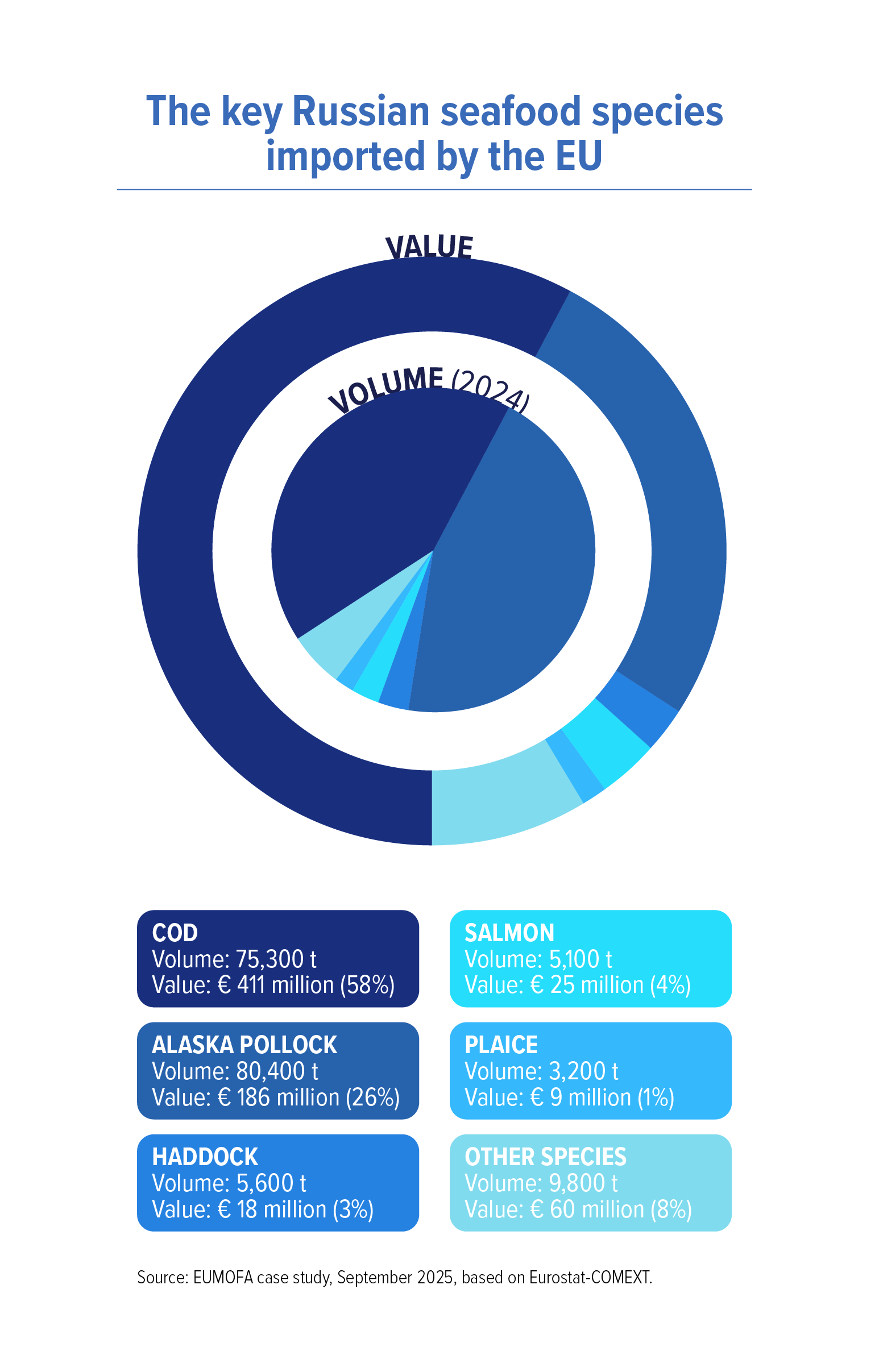
While the EU’s seafood importers have faced numerous threats of outright bans on Russian whitefish, the reality has been far more nuanced – thanks largely to the continent’s insatiable appetite for seafood staples such as pollock, haddock and cod.
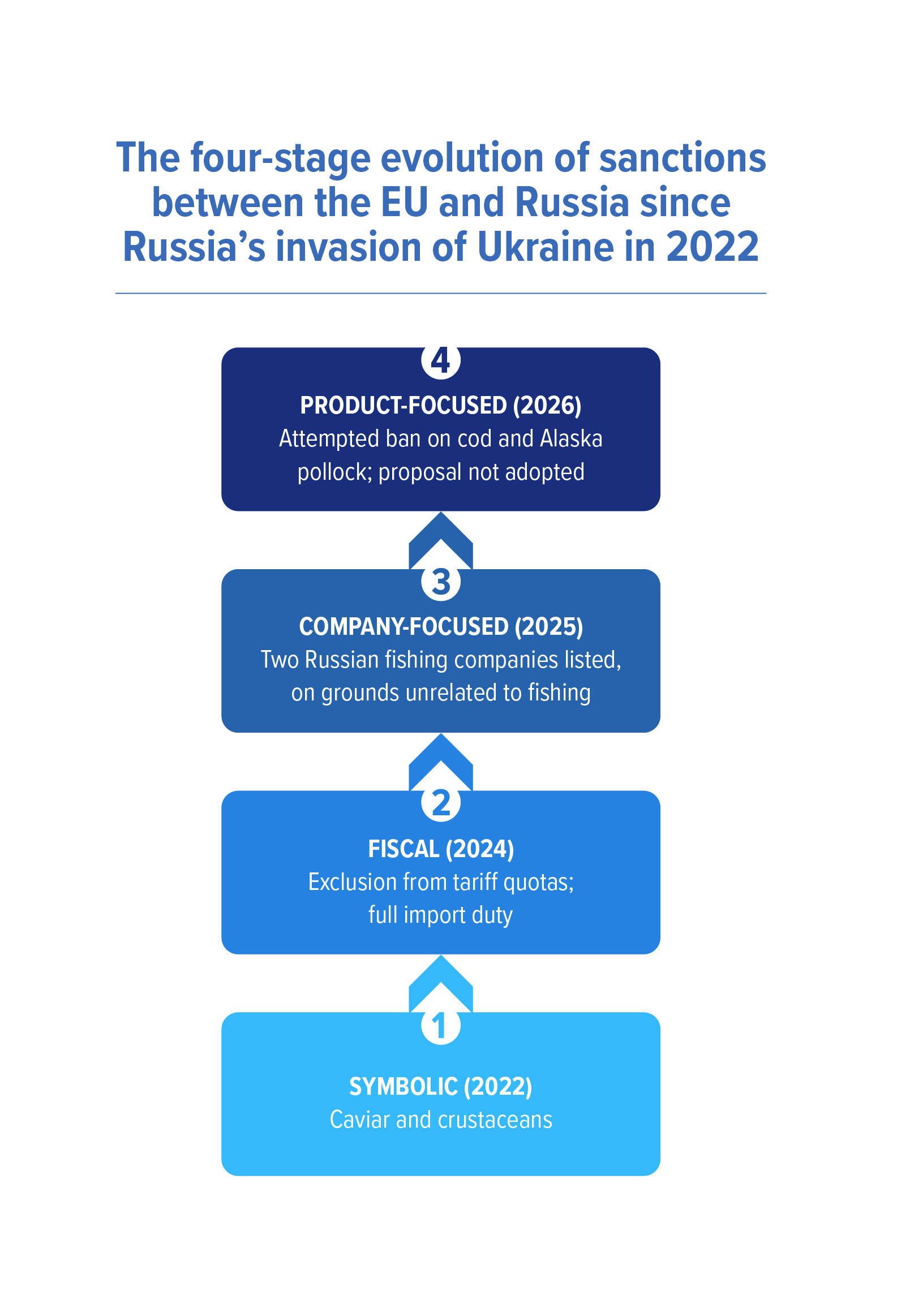
Two months after the outbreak of Vladimir Putin’s “special military operation” in Ukraine, the EU retaliated with its own package of sanctions – introducing an import ban on Russian caviar and crustaceans.
However, despite the growing tensions, in 2022 the EU imported over 200,000 tonnes of Russian seafood, worth almost €1 billion – setting a new record. While this may have raised a few eyebrows, it’s a reflection of the difference between the EU’s attitude towards Russia’s flagship luxury goods and its attitude to cod and pollock, which are seen as essential raw materials for Europe’s thriving seafood processing sector.
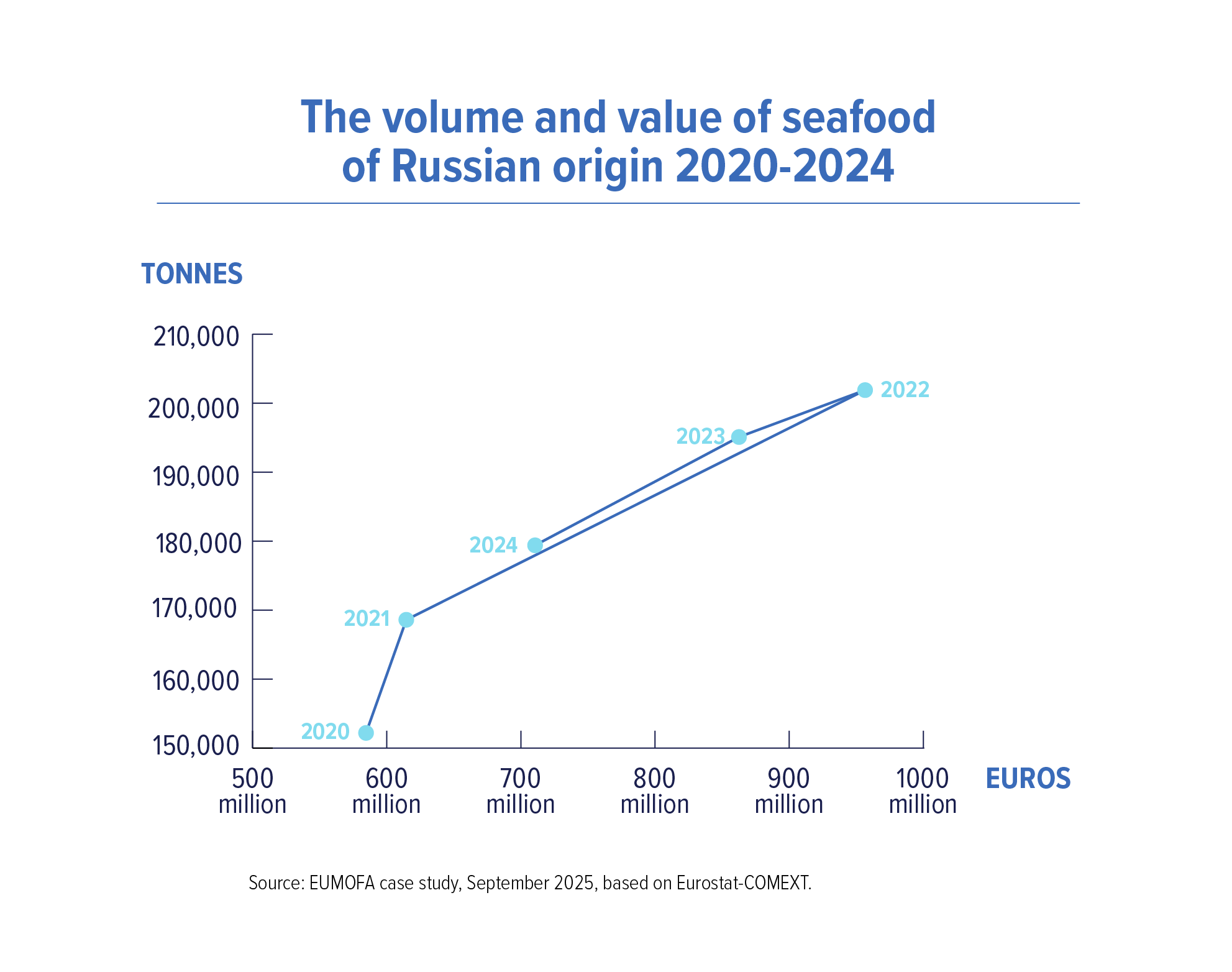
Despite the importance of Russian whitefish, as the war ground on, the EU gradually attempted to exert more economic pressure on Moscow and, in 2024, Russia was excluded from the EU’s autonomous tariff quotas. As a result, seafood products were hit with full import duties (equating to 13.7% for frozen Alaska pollock fillets, 7.5% for frozen fillets of cod, haddock and saithe) – a fiscal measure which many feared would have a significant impact on whitefish prices within the EU.
But, while direct imports declined as a result, the flow of whitefish continued – albeit largely via a more roundabout route – as Russian catches processed in China are allowed to enter Europe as products of Chinese origin, in line with international rules. Meanwhile, Russian fishing vessels were still permitted to land catches in the northern Norwegian ports of Kirkenes, Båtsfjord and Tromsø, which in 2024 equated to approximately 80,000 tonnes of cod, haddock and saithe.
The following year saw the launch of the third phase of sanctions, while vessels from two of Russia’s major seafood exporters were banned from EU ports and waters following allegations of their involvement in a Russian state-sponsored surveillance campaign, marking the first time that vessels from individual Russian fishing companies were barred from EU ports and waters on grounds unrelated to fishing.
Most recently, in an attempt to staunch the flow of euros to Moscow, cod and Alaska pollock from Russia were tabled to face further sanctions, with Ursula von der Leyen releasing a statement that described fisheries as “one of the last major unsanctioned sectors.” On 9 June 2026, more stringent restrictions on Russian fisheries products were proposed, including a complete ban on Russian cod from 2028 and a phase-down for Alaska pollock, with import levels to initially be capped at the 2023-2025 average, then reduced to first 75%, then 50% of the average, according to industry reports.
Six weeks later the sanction package was adopted, but – remarkably, given von der Leyen’s earlier stance – seafood was omitted.
Why the U-turn?
Given the significance of the 179,000 tonnes of seafood products that the EU imports directly from Russia (according to EUMOFA‘s figures for 2024) it’s perhaps no surprise that the proposal failed to gain unanimous approval from all 27 EU member states.
According to recent industry figures, Russia supplied 66,000 tonnes of frozen Alaska pollock fillets into the EU in the first half of 2026 – equating to 51% of the EU’s imports of this product, up from 44% a year earlier. And the reality is that there’s simply no replacement volume available should Russia be blacklisted: Norway’s Barents Sea cod quotas remain under pressure, while most of the USA’s Alaska pollock production is already committed.
Should the EU’s access to Russia’s whitefish resources be denied, then Germany’s massive fish finger processing sector would struggle. As would Portuguese consumers, given that bacalhau is a national institution there. Meanwhile, the Netherlands, France and Poland – all keen whitefish consumers – were also identified as expressing reservations.
Non-political pressure
The possibility of the EU ramping up its trade restrictions is, however, by no means the only way that Western demand for Russian whitefish can be impacted. Indeed, while Brussels debated the level of sanctions to impose over the summer, a parallel battle – which kicked off on the West Coast of North America – has been playing out.
It all started on 30 June 2026, when the At-sea Processors Association (the Seattle trade group representing the US catcher-processor fleet in the Eastern Bering Sea) filed a formal objection to the prospect of the Russian Western Bering Sea pollock fishery achieving Marine Stewardship Council (MSC) recertification.
The following day the commissioner of the Alaska Department of Fish and Game joined the fray – accusing MSC of ‘blue washing’ Russian seafood and writing to the MSC’s chief executive asking it to halt the recertification.
The objection was deemed admissible by the independent adjudicator due to a number of possible issues, including the fishery’s harvest control strategy and salmon bycatch. However, the adjudicator has since explicitly stated that admissibility does not prejudge the outcome and a final decision is yet to be made – the certificate was due to expire on 5 July 2026 and has been extended to 30 December 2026 while the objection runs.
However, should Russia’s Alaska pollock fishery lose MSC certification, the substantial volumes it lands (287,000 tonnes according to the MSC’s 2024 figures) will also lose access to many key European markets.
What’s next?
While the EU’s proposal for an outright ban on importing Russian whitefish may have been shelved, it has yet to be withdrawn, and – should the conflict in Ukraine continue – few would bet against a fresh raft of sanctions being drafted, that might well include Russian fisheries products. Equally, whether the Western Bering Sea pollock fishery achieves MSC recertification is likely to have a huge impact on Europe’s whitefish trade.
Either way, the evolution of Russian sanctions since 2014 acts as a timely reminder of how the seafood sector increasingly needs to adapt and react to disruptions – from Trump’s ever-changing tariff proposals to the shipping restrictions in the Strait of Hormuz. However, with an outright ban on Russian whitefish avoided, Pittman intends to keep our supply lines open regardless of wider geopolitical events.
And, to safeguard against further disruptions, we’re also committed to maintaining a portfolio of suppliers from a diverse range of countries, while ensuring we remain transparent about their origin and where they have been processed.
Meanwhile, the EU’s Autonomous Tariff Quota regulation expires on 31 December 2026, with no alternative yet proposed or adopted. Should the EU fail to replace it, the zero-in-quota rates will lapse for everyone – a move that could arguably be even more consequential than any of the sanctions packages implemented against Russian seafood to date.


Comments